THE DECORATION OF THE STERLING MEMORIAL LIBRARY
EXTERIOR, HIGH STREET FACADE
(Main Entrance, with Reserve Book Room to the left and Linonia and Brothers Library to the right, and, at the Wall Street corner, Exhibition and Rare Book rooms.)
Inscription above the main entrance: STERLING MEMORIAL LIBRARY
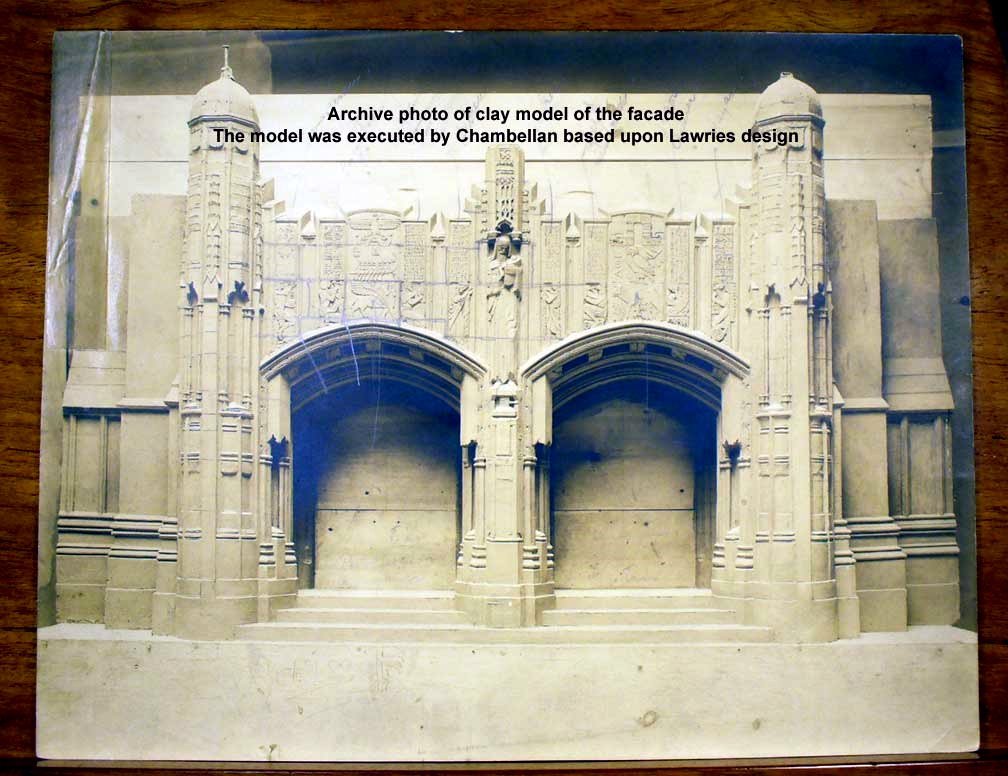
The main entrance is symbolic of the ancient civilizations, based upon written records. The sketch model was made by Mr. Lee Lawrie, of New York City, while Mr. Rene P. Chambellan followed this sketch in his own way in doing the full size sculpture. The doorway is divided into two parts by a figure of a Mediaeval Scholar, the central panel over the left door representing the more ancient civi- lizations: the symbol of Egypt, the Phoenician ship, and the winged bull of Babylon. On each side of this central panel are two panels with Cro-Magnon, Egyptian, Babylonian, and Hebrew inscriptions, with typical scribes below. Identi- fications and translations of these inscriptions are as follows:
Cro-Magnon.
i. Wall engraving of a bison and horse from Les Combarelles. Second phase. Aurignacian epoch.
2. Wounded bison and claviform signs in the Cavern of Pindal.
3. Engraving on a mass of stalagmite in the Cave of La Mairie at Teyjat, Dordogne, France. Third phase. Magdalenian epoch.
4. Wall engraving of a mammoth in the Cavern of Les Combarelles,
Dordogne, France. Second phase. Aurignacian epoch.5. Bone pendant which had served as a hunter's tally. From the Cave of Raymonden at Chancelade, Dordogne, France.
[From George Grant MacCurdy : Human Origins, Vol. I.]
Egyptian.
“Would that I might make thee love books more than thy mother.
Would that I might bring their beauty before thy face. Verily it is greater than [that of] any office.”
From Papyrus Sallier II.
Dr. Ludlow S. Bull writes: "The Papyrus -was actually written down in the XIX Dynasty, about 1300 B.C., but the work itself, which is in praise of schools and education, is shown by internal evidence to belong to the Middle Kingdom, the best literary period. In transcribing the text from the hieratic I made certain changes to bring the inscription into accord with monumental hieroglyphic writing."]
Assyrian.
The wisdom of the god Ea, the science of priesthood, the lore of the wise, that which is suitable for the contentment of the heart of the great gods, upon tablets in accordance with the documentary copies of Assyria and Akkad [Babylonia] I wrote, condensed, revised, and placed in the library of Ezida, the temple of the god Nabti, which is in the midst of Nineveh, my lord. Forever may the god Nabu, the king of heaven and earth, look with joy upon that library and upon Ashurbanipal, the chief, the venerator of thy divinity, grant daily favor! Decree his [continuance of] life! [So] shall I exalt thy great divinity! [Part of a cuneiform inscription from the library of Ashurbanipal at Nineveh. Selected by Professor Dougherty.]
Hebrew.
Lord, thou hast been our dwelling place in all generations.
Before the mountains were brought forth, or ever thou hadst formed the earth and the world: even from everlasting to everlasting thou art God.
Thou turnest man to destruction: and sayest, Return ye children of men.
For a thousand years in thy sight are but as yesterday when it is past: and as a watch in the night.
Thou carriest them away as with a flood, they are as a sleep: in the morning they are like grass which groweth up.
In the morning it flourisheth, and groweth up: in the evening it is cut down, and withereth.
CONTINUED BELOW